Monday, May 15, 2017

Globalization will help the environment


Many people, when thinking of big companies, picture selfish, uncaring men in business suits plowing down trees and forests and all kinds of wildlife to make room for parking lots. Opponents of free trade argue that, by giving businesses the power to expand to other countries without regulations, the environment would be harmed significantly. The truth, however, is that free trade will in fact help the environment. According to Globalization101, a website with in-depth information on the various factors that make up globalization, the free market would be the “best [tool] to solve environmental problems and lift people out of poverty, rather than greater regulation.”
Those opposed to free trade believe that regulations should be put in place that don’t allow certain developments if the businesses of these developments don’t abide by certain environmental rules. As companies will become more selective, they’ll be less likely to start up in poorer countries, causing them to lose the income and job possibilities this company could have given them. Increasing regulations will only make struggling countries poorer, resulting in them being even more unable to preserve the environment. More harm is done on the environment due to poverty and more regulations, than less regulations will.
Third world countries don’t have the luxury to protect the environment, as they themselves are struggling to survive. With more money, which can be obtained through businesses, they could also make or purchase new, cleaner technology. Only when a country can take care of the people can it afford to care for the environment. More regulations on free trade won’t only stop revenue but also force locals to use the land for profit, as they have less choices in making profit. It’s unfair for us to force other countries to protect the environment when they’re struggling to survive as it is. Allowing the free market to earn countries money will result in the protected environment we all hope for.

Monday, May 8, 2017

Government needs to do more

The one thing everyone can agree on is that we all love food.  No matter what kind of food you choose to eat, we all use food as a to socialize and connect.  When it comes to what we eat, however, our country is not making the best decisions that it can.  The government should do more to promote healthy eating and making smart dietary choices so that when we eat, we can eat smarter and healthier.  If the government does more to spread knowledge and information about the food we are eating now, we can still enjoy food and going out to eat, but we can benefit our bodies while enjoying food instead of damaging our bodies.
In my second post i talked about how going gluten free can reduce inflammation in our bodies and can lead to healthier diets.  With this information, the government should pass that knowledge on to all its people and not keep it a secret.  It is not fair to the people that have to still eat gluten filled foods that break their bodies down when there are healthier options out there.  If the government played a bigger role in the food industry, people like michelle obama whose main goal as the first lady was to reduce child obesity.  During her time when her husband was in office, she focused more on exercise than eating which is not good knowing that if we reduced the amount of gluten in our diet we could cut down on inflammation and the kids would not be as fluffy as they are now.
In my third blog post I talked about an article that addressed the government directly.  It talked about how the last thing that the government did to influence our dietary choices was in 2011.  Even when they do intervene in the food industry, it basically restates something or makes a law or act about something that has already been addressed in the a majority of restaurants and food manufacturers nationwide.  Things that restaurants and food manufacturers are not taking into consideration is the nutritional value of their food.  This is what the government should be focusing on because they are allowing our food industry to poison our bodies with the food that they are selling to us and advertising as healthy and good for our bodies.
In my fourth blog post I talked about how GM foods, which were introduced in 1994, have slowly made their way into all of our diets and has infiltrated our foods.  GM foods cause more problems than benefits for our bodies such as artificial allergies to some foods such as peanuts and soy.  GM foods are a way for manufacturers to grow things faster and cheaper, but that does not always mean healthier for the consumer.  These GM foods are slowly killing us and causing our dietary habits to evolve.  Our bodies are not used to all the GM foods that we now have in our diets and it is showing especially in younger generations.  The government should research GM foods and understand what they do to our bodies so that they can advertise against them or put in regulations for the food industry to follow.

Trump Beefs Up Immigration


The Trump administration has recently decided to pursue its policies on border and immigration enforcement, the policy also includes the rights to negate the Deferred Action for Childhood Arrivals, which allows 2nd generation illegal immigrants to apply for a work permit. Border enforcement and the expulsion of unauthorized immigrants who are considered law-breakers has been part of his CPAC speech. Trump has also addressed a joint session of Congress for the first time as president during an evening event covered live on television. The most frequently cited and recent federal estimate is that 11.1 million undocumented immigrants live and work in the United States. The White House said Tuesday the estimate could be as high as 15 million.“We will have more actions, and the President continues to see that immigration is one of those issues that he was very, very clear and consistent on in the campaign. And we're going to continue to implement the policies that he talked about to keep the country safe,” Spicer said.

Trump's immigration policy hurting Americans


The economic value I studied is the idea that President Trump’s immigration policy is setting a backlash on Americans and more importantly immigrants. The travel ban has already started decreasing tourism in America from foreigners, causing billions of potential dollars to be lost. According to the Chicago Tribune, New York being the most travelled city in America for foreigners has already seen a 2% drop in tourism this year. This will mark the first decline in New York’s tourism in eight consecutive years. With Trumps plan in act the U.S. will lose about 4.3 million international visitors which will translate to 7.4 billion deficit of lost revenue. Critics such as John McCain believe this ban will only feed ISIS and help aid recruitment. The Syrian Civil War has already killed about 400,000 civilians and the number only increases everyday. Additionally, the US refugee program has been issued an 120 day suspension. The US will not accept more than 50,000 refugees a year, decreasing the 110,000 cap from the Obama administration.

Marketing to the LGBTQ+ community will lead to success

                                      Marketing to the LGBTQ+ community will lead to success


                                                             time.com

With the spending power of the LGBTQ+ community at a whopping $800 billion according to Business Insider, companies that make an effort to market to this community have a lot to gain. However, it does take a sincere effort and plan to successfully market to the LGBTQ+ consumer. Trite stereotypes and a lack of understanding of the nuances of the LGBTQ+ community will not lead to success when marketing to this community. Successful marketing to the LGBTQ+ community requires that companies recognize the diversity of this community and are sensitive to the fact that the LGBTQ+ community encompasses diverse individuals who do not always fit the stereotypes placed on them.

The LGBTQ+ community is diverse, made up of individuals from many different backgrounds with a range of beliefs and values.  In her article How Advertising Depicts Gays and Lesbians,” Julia Hanna of the Harvard Business School asserts that the characterization of LGBTQ+ individuals in mainstream advertising is lacking in diversity.  She states that companies resort to stereotypes because they are uneducated as to the many different types of people in the LGBTQ+ community. These stereotypes actually turn off the the LGBTQ+ consumer.  One way companies can avoid this by using real gay, lesbian and transgender individuals in their advertising, including well known celebrities, which adds authenticity.  Another way to avoid stereotyping is to show LGBTQ+ individuals in average, everyday situations. Marketing successfully to the LGBTQ+ community requires accurately portraying that community.   

Despite the obvious financial benefit of marketing to the LGBTQ+ community, some companies still do not actively market to LGBTQ+ individuals. According to the huffington post companies such as Chick-fil-a, Urban Outfitters, and Exxon do not support of the LGBTQ+ community. Understandably, many people in the LGBTQ+ community refuse to buy from companies that do not support LBGTQ+ rights. The articleUnderstanding the Multi-Billion Dollar LGBT Market points out that members of the LGBTQ+ community are loyal consumers. For example, 70% of LGBTQ+ adults would actually pay more for a product from a company that supports the LGBTQ+ community. Companies that do not support of the LGBTQ+ community not only stand to lose out on the potential positive impact on their business of this great market segment, but may be directly negatively impacted.

Without a doubt, the LGBTQ+ market segment offers tremendous opportunities to businesses that are willing and able to address the needs of these consumers. According to a Gallup, approximately 9 million adults in the U.S. identify as LGBTQ+.  And LGBTQ+ consumers have two to four times the buying power per person than other niche groups like Hispanics and African Americans.  To market to this group of consumers effectively, companies must be sensitive to the diversity of the LGBTQ+ community and avoid stereotyping the members of this community.  
   

That's a wrap

What compels students to be involved in Greek Life? I have concluded that people join to feel included. Young adults want to be able invited to social events if it’s a fundraiser, a dinner, or a party we as humans have the urge to make connections with people. The exclusiveness of Greek Life makes it even more inviting. To be in an organization you have to interview, dress up, get references all of these are challenging tasks so those who can accomplish this seem like a different breed. The article “Joining the Panhellenic Association” clearly explains the task. Also, being apart of Greek Life gives you a leg up on your future. In today’s society, we worship those who can go party on the weekends and then maintain a perfect GPA, who cares if you’re among drugs and underage drinking as long as you can take a snap story. Like “The Dark Power of Fraternities”, written by Caitlin Flanagan said it’s part of growing up.   I am not dissing on those who join, heck, I’ve wanted to be in a sorority since I knew what it was, but my motive for joining is so I can have an exclusive group of friends.

Advertisements are Responded to in Predictable Ways


The economic principle I examined was, “People respond to incentives in predictable ways”. There are many examples of how this economic principle can be applied to the real world. While studying advertising I found many examples of this principle. First, companies create incentives for their consumers through social media. Social media is the cheapest way to effectively advertise to a large audience. It is the cheapest way to advertise because it’s the easiest way to target specific audiences and certain demographics. This shows that through technology companies can target exactly who will be most interested in their product, leading to an increase in sales per view. Second, companies create incentives for consumers through bold and irrational claims.  Irrational advertising is when a company claims or shows that a product will do something for consumers that it will not actually do. Skechers used irrational advertising to sell thousands of shoes, convincing people the shoes would tone their legs and behind without any workout beyond their daily walking. The company even made claims about the shoes helping people lose weight.  Sketchers made millions of dollars before the FTC fined them and stopped the sale of the shoes. In many cases the FTC never comes to the consumers rescue. This demonstrates that if companies make bold claims about their product in advertising, consumers will listen and buy the product based on those claims. Third, repetition is used by companies to give consumers an incentive to buy their product. This means that messages are more effective when repeated. Overall, you can see that the placement and frequency of an advertisement greatly effects the influence an advertisement has on consumers.   

Recruitment or Job interview?


Courtesy of Huffingtonpost.com

Although I am four long years away from entering the competitive adult job market the idea scares me and I constantly think: “What can I do to make myself a better candidate?” According to “People Who Were In Frats And Sororities Are Better At Their Jobs” from Business Insider and “5 ways Greek life will help further those career goals of yours” from US Today: College joining greek life will put students ahead in the job market. Being apart of Greek Life helps you grow connections and rushing for a sorority or fraternity is like a job interview, you are trying to sell yourself as the best possible candidate. In this blog post, we will see how greek life helps students with their future careers.


In US Today: College’s article the author, Nóra Horváth, talks about the connection she made with her boss through sororities “Alumni love to help out younger members. Just recently I found out that my boss’s wife was in Tridelta at Syracuse, and he told me that if I needed anything from either of them to not hesitate to reach out.” A connection like this can help her move up the ladder at her workplace and possibly land this author a job with a kind recommendation from her current employer. Connections don’t just come by word of mouth, social media and social networks are huge in the job work today “most sororities have alumni networks through platforms such as LinkedIn and Facebook – making it easier than ever to get connected.” Companies can look through these platforms when looking for an employee. Also, people tend to have a preference toward someone if they share something in common, with Greek Life being such a prominent organization in today’s culture it’s easy to find someone who has a Greek Life connection like you.


While rushing for a sorority or fraternity students must go through a meet and greet, an interview, and social media checks, it mimics a job interview. Business Insider’s, Peter Jacobs says  “Recruitment breeds good interview practices – what kind of questions to ask someone, how to seem friendly without being creepy, and how to talk about your experiences in a way someone who’s never experienced them can understand. In an interview, your job is to sell what you can do for an employer, and sorority recruitment is very similar – selling what the organization can do for the potential new member” An interview is to see if you’re right for the greek organization just like when interviewing for a job.

Greek life does not just help you explore and branch out during a student's college years but it also helps students when they are starting their careers. In the job world, today connects are very important so making them where you can give you a leg up against all the other interviewing for the same position as you. In a psychology study done by a Harvard professor people are more likely to like you if you have something in common as them, it doesn't mean you have to be in the same sorority as them, but being involved in Greek Life gives you a leg up.

Synthesis


                                                     http://cdn.static-economist.com


       The economic principle I examined was Institutions are the rules of the game. There are many examples of how this economic principle can be applied to the real world.  While studying Illegal Immigration, I found many examples of this principle. The first principle was from the Atlantic's article "does Immigration Harm Working Americans?" From this article I argued  how Illegal Immigrants are in fact helpful towards our economy by stimulating growth in the private sector and providing much needed labor and skills. This shows that these while these immigrants are taking jobs they are doing so in a manner that has a positive effect on our own economy.
       In my second principle, I elaborated more on how illegal immigrants have a positive effect on the economy.  In the article "The Truth About Undocumented Immigrants and Taxes",  I discovered an enthralling and quite frankly surprising detail that illegal immigrants pay more than their fair share of taxes. If it weren't for this influx of income tax money the already flailing retirement trust fund would run out much sooner than expected. This also demonstrates how Illegal immigration affects our own economy positively.
      My third example comes from Robert Reich's article "Six Reasons why Trump's Mexico Wall is a Bad Idea". In this article, much criticism is handed down on the proposed plan that Trump is now infamous for. Simply put, The wall would cost far too much, contradicting why the wall would be put up in the first place. While also mentioning how that Illegal Immigration has dramatically dematerialized, and how the border is already strong enough considering the costs.  This means that Trump's wall is more of a fiction and not a realistic solution, and how wishful thinking is not an appropriate response towards the situation regarding Illegal Immigration.
      Overall, you can see that there is more than just one side to the rhetoric that surrounded the previous election.  That there are many factors surrounding Illegal immigration whether it be cultural, economic or moral.  And that is why it is there is so much controversy, fear and importance towards this subject which is why this will most likely be a likely topic to debate for many years to come.

How to Resolve Illegal Immigration

                                                             http://c10.nrostatic.com

When we look at immigration, we find that there is no clear answer to simply just removing people from a country where so many have contributed so much.  If deported, their hard work and sacrifice would be a costly shame both literally and figuratively.  As said before, the process behind actually deporting these people would be costly and time consuming.  It is not so simple to just take a person and put them back where they came from.  These very same people although not American citizens  still have their fourth and fifth amendment rights, and that means a lot of court hours. And the Wall has so many fundamental problems that it's not even worth looking over.  But is there another solution that would reward Immigrants who have obeyed the law? And at the same time provide an efficient and cost effective way of integrating Immigrants into our country with minimal to none repercussions? The answer is right in front of us: Through Registry.

In the Forbes article "How to Resolve the problem of Illegal Immigration In America" by Andy J. Semotiuk, an established lead immigration writer, says "As of 2014, the latest year for which we have statistics, the median time an undocumented adult has been living in the U.S. is 13.6 years. What is more, about two-thirds of illegal immigrant adults in 2014 had been in the U.S. at least a decade." Of that estimated 10 million, two thirds of which have been living normal, decent and hardworking lives for over a decade without a criminal background of any sorts. Their contributions through taxes and their attempt at citizenship through their participation in their communities should exempt them from any persecution from authorities. I must attest however, I should state that Illegal Immigrants who have not been compliant with our laws, and who do not have a moral compass should be deported as President Trump already plans to do. But for the majority of those who abide by the law, the new administration should make becoming an American much easier than it currently is. There must in fact be qualifications to fully register of course, with residence of over ten years being the standard. And no history of a criminal record, or ties to terrorism. But by integrating these immigrants into our system, it will make the more hairy parts of expedition and border control much more efficient and cost effective.

It is quite clear that these Immigrants who contribute to our communities do more good than harm, That is why I see that the best way to end the debate to Illegal Immigration is through more a more lenient amnesty process. This leads me to my next question: Would this policy attract more illegal immigrants to our country?


What's the Connection?

The economic principle I examined is the idea that government can improve markets and personal wealth. There are many different examples of how this economic principle can be applied to life. While studying Trump’s taxation policies and his effect on people and the market, I found many examples of this principle. First, Donald Trump claims that he will decrease corporate tax by twenty percent which will help bring jobs back to the United States and prevent companies moving from overseas. This will ultimately help the economy because it will bring bing corporations back to the stock exchanges. Secondly, Trump says his taxation will ultimately help investing. In an article from the Washington Times it says “the corporate tax will be cut in half, investor taxes will be down about 15 percent and money will flow back to America from a lower repatriation tax. . .  the lower taxes on businesses and investors will translate into trillions of dollars of gains for investors and pension funds with wages and GDP surging too.” This will bolster people’s confidence in investing. Finally, Trump claimed that he would lower taxes for the middle and upper class. If he does this, people will be more likely to take that extra money and invest it back into the economy in stocks and bonds. Overall, you can see that lowering taxes and making it more a free market society will improve markets and personal wealth.

Sunday, May 7, 2017

The Facts of New Drugs


   The economic principle I studied over the past semester was, people respond to incentives in predictable ways with the question of, "how are drugs incentivized?"  The reason behind this topic was due to my knowledge of the incredibly high prices for medication like epipens, which people are in dire need of.  Many times, drug companies will take advantage of the fact that you need new drugs for well-being, and will keep prices high in order to make more profit.  The problem is that with drug prices so high, some people cannot afford medication which they need.  I looked at why these prices were so high, and how prices could be lowered by means of incentivizing drug companies to do so.  


www.princeton.edu
   In the second blog post, I researched the article "Creating New Economic Incentives for Re-purposing Generic Drugs."  It states how, "Policymakers from academia, industry, and government have called for federal initiatives to stimulate drug development. Most proposals target the intellectual property environment, because market-exclusivity periods, usually supported by patents, foster revenue generation in the pharmaceutical market."  Having more incentives boosts the pharmaceutical market, and help companies that are looking to make money be ready to pump out more drugs.  This will also help them not spend as much money on drugs by re-purposing, in return lowering the price for the consumer.  

   In the third blog post, I researched the article "Using Market-Incentives to Promote Pharmaceutical Innovation."  This article addresses the issue of pros from incentives for new drugs by explaining how government policy has changes to encourage new drugs to be put out on the market.  It explains the various outcomes that occur due to increase in drug production, as well as acts Congress has passed to further research and development of drugs.  Having more incentives boosts the pharmaceutical market, and help companies that are looking to make money be ready to pump out more drugs.  This will also help them not spend as much money on drugs by re-purposing, in return lowering the price for the consumer.  With drug prices lower, people will be able to afford drugs they need.

   In the fourth blog post, I researched the article "A systematic review and critical assessment of incentive strategies for discovery and development of novel antibiotics."The article states that having public funding is a good thing, but many times privatizing funding halts drug growth because of the incentive to make new drugs to make money for oneself cause companies to withhold information which if put together could help develop drugs faster.  By having an incentive to make money, this causes lack of research to be shared which can be detrimental to be making drugs for infectious diseases.  This article essentially is saying that having incentive to create foster new development of drugs to combat infectious disease is important and intentions good, but sometimes having too much incentive can halt growth and development of new drugs.  Companies want to make money, but by having to many incentives it can stop them from making it, halting drug production.  This may be part of the reason why drugs take so long to be made, because of negative incentives which are involved.

   In my fifth blog post, I researched the article "Mylan’s EpiPen Pricing Crossed Ethical Boundaries." In this article I read about the ethics of making drugs for help and money, and where to balance the two.  As we continue to develop as a world, new and improved drugs continue to come out.  Many of these drugs are vital for some people to lead a normal life.  One of these drugs is the EpiPen.  An EpiPen is a brand name for an epinephrine auto-injector device used to manage potentially life-threatening anaphylactic reactions to allergens.  Essentially if you are having a life-threatening allergic reaction, it will save your life.  The problem is that the company Mylan which makes it, like many others, takes unfair advantage of the fact you as the consumer need this product.  They use their monopoly status to keep prices high, to increase their profits.  I believe that having a monopoly over a drug is wrong when the producers keep the drug price high and out of the hands of people who are in need of it.  Reading this article allowed me to identify where the line I see should be drawn regarding the ethics of drug prices and availability.


Sports Incentives

The economic principle I examined was how sports teams creative incentives to get fans to buy merchandise and go to games. There are many examples of how this economic principle can be applied to the real world. While studying the incentives sports teams use, I found many examples of this principle. First, major sports leagues like the NBA do things like bring games to Mexico. This shows that they are wanting to expand to get a larger fan base for the league. They are also thinking about putting sports franchises in different countries. Second, people want to represent their favorite sports teams, city, and players. This demonstrates that people will pay large amounts of money to wear sports gear. Third, sports teams provide in game promotions or giveaways that attract fans. This means that fans think they are getting a good deal by buying tickets to an event when they pay to watch the game and the promotions and giveaways are bonuses that come along with it. Overall, you can see that there are many incentives for fans to buy merchandise and go to the sporting events.

Why U.S. Education is Sub-Par

        The economic principle I examined was institutions in the form of public school. While studying this topic, I came upon some interesting facts. The U.S. has a very sub par education system. Our literacy rates are below that of some third world countries(post4, Gatto 11),  with alarming statistics within our country. Other countries such as Japan and Norway have adopted a more progressive, or more life based education system and their countries have prospered. (Post3, Khoo) Assuming that the U.S. would hop on the bandwagon, I was surprised to learn our literacy rates haven't moved in ten years.(Huffington post, The U.S. Illiteracy)
All of this research raises the question, if the U.S. knows of better ways to educate us, and obviously has the funds to do so, why isn't any action being taken? This is where John Taylor Gatto's book Weapons of Mass Instruction came in handy. He explained how it is actually in the interest of the government and large corporations for the mass population to be a servile one. Beyond literacy skills, how much of your freshman classes content do you remember? Was it almost like they were training you to accept doing pointless tasks? Gatto makes the argument that schools real purpose is to do nothing more than to create a fixed reaction to authority, and give us the skills and mindset necessary to work for someone else forty hours a week. Not only this, but someone who can not think for themself is the ultimate economy booster. How? They are incredibly susceptible to marketing, and will consume non stop.

Saturday, May 6, 2017

How can companies motivate employees to be healthy?


The economic principle I examined was Incentives. There are many examples of how this economic principle can be applied to the real world. While studying the different benefits a company can provide their employees, I found many examples of this principle. First, the first important step is to devote to wellness promotion in the business. This means that an employee's health is more than just medical costs and workplace wellness is definitely worth the investment. Second, there are many different benefits a company can offer its employees, a gym or a daycare in their office building. Fun activities, picnics, and team building exercises can also be a  part of their program. This demonstrates that employees with a balanced work life are less stressed and more motivated at work, which automatically increases the company's productivity. Third, I think health benefits can be very beneficial for both the company and their employees because with health benefits employees tend to take less sick days. This shows that a company could offer health benefits to their employees for five various reasons; attraction, retention, morale and productivity, compliance and simplicity. Overall, you can see that there are many different programs to encourage individuals to adopt a healthy lifestyle. A healthy workforce is a more productive workforce.


Friday, May 5, 2017

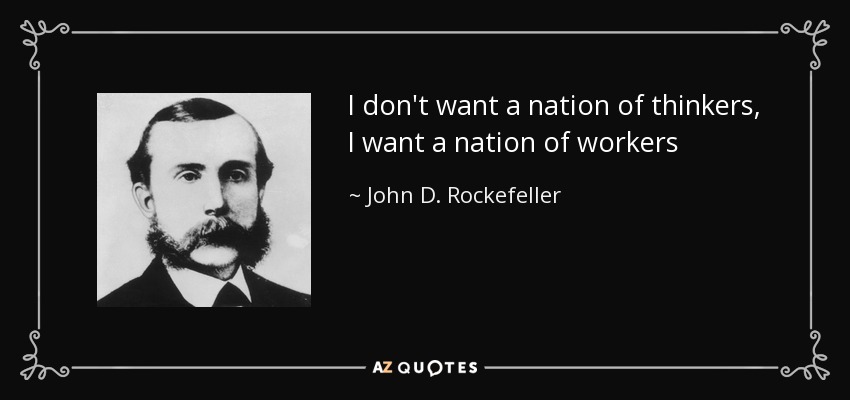
Systematic Dumbing Down of People for Marketing Success.


- John D. Rockefeller, Creator of the General Education Board (GBE) in 1903. 
http://www.azquotes.com/picture-quotes/quote-i-don-t-want-a-nation-of-thinkers-i-want-a-nation-of-workers-john-d-rockefeller-60-70-52.jpg 

American education has been in a downward spiral for quite some time now. As a country the U.S. used to represent a good free public K-12 education system. Today we are lacking behind even some third world countries in literacy rates. It is not like we do not have the scientist, funding, or resources to once again become a top educated country, so why is this? To find the answer we must look elsewhere. 

Emanuel Paparella, PH.D., believes this is all purposeful. Part of an agenda to control and exploit a population. In his article “The Mass-Dumbing-Down of America: Donald Trump as the Canary in the Cave of Ignorance” explains,  “The most obvious example of how Americans have been dumbed-down is through this nation's failed public education system. At one time not that long ago America reigned supreme as a leading model for the rest of the world providing the best quality free public K-12 education system on the planet. But over the last many decades while much of the rest of the world has been passing us by, it seems an insidious federal agenda has been implemented to condition and brainwash a population of mindless, robotic citizenry that simply does what it's told, and of course the brainwashing commences early.” It takes place through compulsory schooling, which John Gatto explains in his book Weapons of Mass Instruction. He explains one function of modern factory style education. “The integrating function. This might well be called "the conformity function;' because its intention is to make children as alike as possible. People who conform are predictable, and this is of great use to those who wish to harness and manipulate a large labor force.” So what use is a dumbed down populace? 


If you had to sell a useless but visually appealing device, would you choose to sell it to an educated person, a practical person, an intellectual person, or a child? The choice is simple, children will consume the product most often. John Gatto explains what this could mean for big corporation and government officials that need to boost the economy at any cost in his book Weapons of Mass Instruction. “the Prussian system was useful in creating not only a harmless electorate and a servile labor force but also a virtual herd of mindless consumers”(xx). In the U.S., we see people mindlessly buying, buying for brand instead of practicality. The prussian system he refers to trains people not to think for themselves, leading to an entire populace vulnerable to a new phenomenon. Marketing. Up until recently, people choose products based on what they made of them. Today people will believe based on look of advertising, wanting to associate themselves with the looks.  

Synthesizing Research On Marrying Into a Culture, Religion, or Race Different than Your Own


The economic principle that I examined was Institutions and cultures. There are many examples of how this economic principle can be applied to the real world. While studying what kinds of things people give up or gain, or the challenges that people go through when they marry into a different religion, race, or culture, I found many examples of this principle.
First, the different challenges that couples may face in a multicultural marriage can include troubles with deciding what side of the family to spend what holidays with, deciding where to live if you come from two different countries, and even giving up some of the traditions that you once did and trading them for different ones.  Ashley Bess Lane talks about the challenges she had with her marriage in “Cultures Collide: 6 Things To Realize Before Marrying Someone From Another Country. Lane is an American woman who married an Englishman from the UK. Bess talks about the challenges that an multicultural couple may face while married with ways to get through them. Bess states that As an American who has married an Englishman, I can safely say that marrying someone of a different background is both exciting and interesting. It also requires a lot of empathy and understanding on both of our parts.” Bess understands that there are going to be challenges and there are going to be some rough spots along the way, but the most important thing to remember is that it is all worth it in the end. Secondly, similar to multicultural relationships comes interracial relationships. There are going to be challenges with what people say about you as a couple, how you decide to raise your children, and sharing different traditions. An article from the Spruce written by Sheri Stritof called, The Challenges of an Interracial Marriage,” they talk about the challenges that come with marrying somebody from another race than your own. Problems from family, friends, and even strangers can be an everyday struggle. Also the problems that a couple may even face coming from two different races. Stritof talks about similar ideas to Bess in that communication is key. If you are not able to talk to your partner about the difficulties that arise and how to get through them then you aren’t going to make any progress. The best way for your relationship to stay healthy is to face all of the problems that arise together. Lastly, despite the problems and challenges that couples go through, why would they do it if they know what they may experience? María J. García San Martín is the author of her own blog called “Stop and Learn English.” A piece titled Advantages and drawbacks of cross cultural marriages,” where she talks about why people actually go through with a cross cultural marriage despite the problems that a couple would face. According to the source “marrying a foreigner is an exciting adventure, and despite the variety of special, new and strange issues it might arise, it could be though, interesting and challenging.” Despite the challenges and rough spots that a couple may experience throughout their relationship, being together is more important that being apart.  
When most people are getting ready to marry the love of their life they aren’t thinking about the sacrifices, the challenges, and the hardships that they are going to face as a couple. When you marry someone from another culture, race, or religion it can come with decisions like choosing what traditions you are going to follow, where to live, whose family to visit during holidays, and how to raise your children. All of which come with challenges and sacrifices that have to be made in order to make the relationship work. Although it may be difficult to handle, there are definitely ways to get through the problems that may arise in relationships like these.

The Principle


The economic principle I examined was "Institutions are the “rules of the game” that influence choices." There are many examples of how this economic principle can be applied to the real world. While studying air pollution found many examples of this principle. First, The institutions that we have implemented in our society can cause great deals of good that can happen because of government programs. The EPA was an Organization which the government made to help put an end to air pollution as mentioned in my second blog post  "Government's Air". This shows that the institutions have tried to make our society better and preserve our breathing air. By making organizations and letting them fight it. Second, institutions can also make it worst depending on who is running it. In my third blog post “The Government is Choking Us”. The government hurts the fight against air pollution by slashing the EPA is budget, or by having the president of the United States not believe in the change in our environment.  This demonstrates that institutions can harm us and just as easily help us. They are harming us by not help aid a fight about a real problem that can harm everyone a lot more. Third, the institutions that don’t help will get hurt if not directly, indirectly from the bizarre things that could happen to the earth if the ozone layer gives out on us. The things that could happen to us in a matter of five seconds are mentioned in my fifth blog post “No Air” This means that everyone will get hurt at the end institutions can harm themselves and help themselves by not hurting the opportunity that is given to solve solutions. Overall, you can see that Institutions can either benefit the people, hurt the people, or even hurt themselves. They can do all of this by supporting one side or the other.

How the NBA attracts new fans


Recently, the NBA has done things like take games to different countries like Mexico for a couple games a year. “On the 25th anniversary of the first regular-season games played in Mexico, commissioner Adam Silver said fans can expect the NBA to bring more contests into the country” (Wright). This has brought many Hispanic fans to NBA in going to games, watching them on TV, keeping up with teams on social media, and purchasing gear. Not only can fans in Mexico expect more games, but according to ABC, “the league is also exploring the possibility of adding a franchise in Mexico City, as well as a Development League team in Monterrey, Mexico” (Wright). This would definitely attract a new and larger fan base to the league.
You can tell the NBA is more than just an NBA than a business because star power brings in more fans more than winning, “The NBA has a lot to do with star power; they call it 'the LeBron James effect,' StubHub communication manager Cameron Papp told CNBC recently. Because of that dynamic, winning is not always the most effective way to bring in revenue. "Anytime he comes to an opposing team's area, sales boost by usually 15 percent," Papp said. "The same thing is starting to happen for the Warriors, whenever they are in town” (McInerney). It makes sense, as you always see little kids wearing their favorite player's jersey no matter what team they play for so you’ll see them go to those games more often than going to the best teams games, “Winning by itself is not enough to bring fans to the arena. NBA ticket sales and attendance for some franchises are heavily influenced by the market and marquee players, according to ticket sales site StubHub” (McIneterey). I think the NBA should keep doing what they are doing because in terms of business, they keep rising.

Ex convicts are an untapped job market


The economic principle I examined was how people respond to incentives in predictable ways. There are many examples of how this economic principle can be applied to the real world. While studying ex convicts in the job market I found many example of this principle. First, Business owners both small and large often overlook the ex convicts because they believe they would not be loyal employees. However, often times these are the employees who would show the most loyalty because they know they are most likely not going to get another chance. Second, Businesses have a golden opportunity to hire employees that are proven to not only save money but are just as reliable as other employees which reduces turnover rate. As Mike Green of the Huffington Post put it  “Ex-felons have far fewer options than conventional employees. Having a high turnover rate within a business can be detrimental to its growth. If employers are constantly having to worry about hiring people who won’t leave it can take take their attention away from other important matters. Third, there are bottom line incentives that include substantial tax credits for businesses. Some states even provide partial wage reimbursement, additional tax credits, and other training funds for employers who hire ex-felons. Overall, you can see that businesses would be foolish to not hire an ex convict if it can hire loyal employees, get tax cuts, reduce the turnover rate, and reduce overall unemployment.

Globalization will help the environment

daks2k3a4ib2z.cloudfront.net Many people, when thinking of big companies, picture selfish, uncaring men in business su...